


I've been in the process of completely overhauling my closet.
After learning more about polyester and what it means for both our health and the planet, I’ve started looking at my clothes very differently.
I understand that polyester has its place. I’m not naïve enough to think I can avoid synthetic fabrics altogether. But I’m in a season of my life where I want quality over quantity. I want to LOVE everything in my closet. I want every item to last a very long time or at least bring me joy or it shouldn’t be there.
And honestly? I am still getting over the fact that I never realized polyester is literally plastic. Cheap, synthetic, overchemicalized PLASTIC. The stuff that makes you smell bad, sheds microplastics, and doesn’t break down so it sticks around in the environment for a very, very long time.
So, as I’ve been going through my closet and pulling out the pieces that are 100% polyester, I have been shocked by some of the brands I trusted, and honestly have always loved. I feel pretty duped.
Like… why am I paying $200 for essentially the same plastic fabric that SHEIN is selling for $15?
And the funniest part is that I work in marketing.
Haha.
I’ll tell you why
It’s marketing.
I don’t know about you, but I want to pay for the quality and craftsmanship of a product, not the millions of dollars a brand spends convincing me that I need a $200 piece of clothing that is essentially made from the same material as a $15 fast-fashion garment.
And then I buy it, wear it against my skin, wash it, shed microplastics into my skin and the water, and eventually throw it away. Cool cool cool.
One of the biggest things I’ve learned since launching Hello Small Brands is that you can shop better without compromising style. You just have to know better.
So, with that said, I want to caveat this list: I do not think these brands are inherently bad. Many of them sell beautiful pieces and I’m sure there are plenty of exceptions within each collection (maybe).
What I do know is that I’ve found a lot of pieces from these brands that are 100% polyester and priced like they’re luxury goods.
And that’s where I’m breaking up with them.
Here we go.
1. RESA
When I first discovered RESA a few years ago, I was genuinely SO excited.
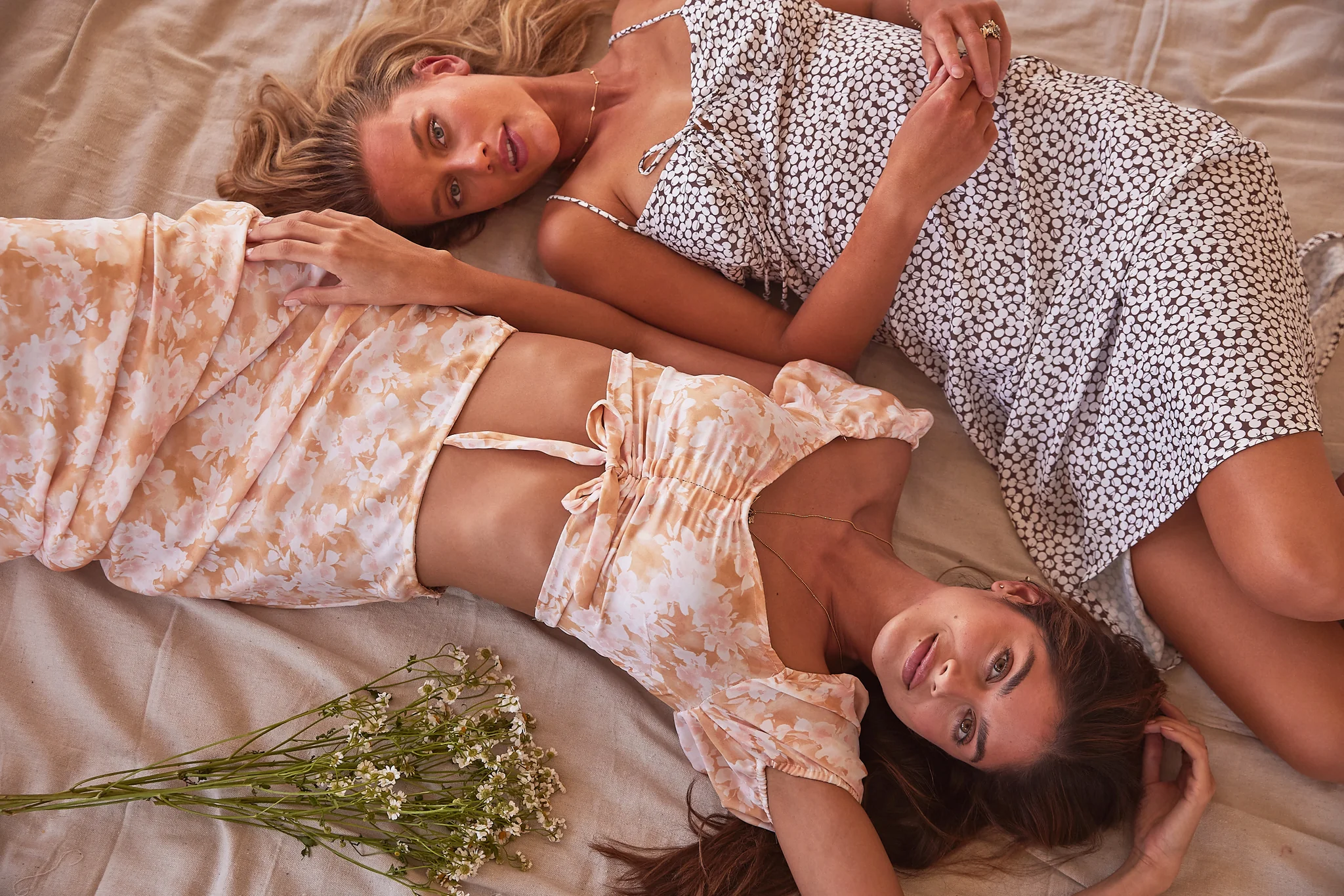
Their dresses are feminine, stretchy, flirty and fun. They felt really unique at the time, before they became as popular as they are now. Naturally, I bought a LOT of them.
Which is why I’m now scratching my head wondering why RESA is charging around $180 for new pieces that are 100% polyester.
I’m sorry, but I just can’t unsee, unfeel it and almost “unsmell” it now.
RESA, I loved you. But I think we need some space.

2. FREE PEOPLE
Now, I know Free People is enormous and wildly loved, and I also know they have a huge range of materials across their collections. But every single Free People item I pulled out of my own closet was 100% polyester. Including a matching pajama set that I LOVE that they charged me $200 for!!
And suddenly, a lot of things are making sense. Like why I would wake up in the morning smelling like B.O. after sleeping in my favorite pajamas.
Yuck. Boy, bye!

3. ARITZIA
Don’t even get me started here. Aritzia used to be my go-to for in-office clothes, monochromatic outfits, and basically anything that made me feel like I had my shit together.
I have spent entire paychecks in this plastic-loving hellhole. And I only realized JUST NOW how much polyester is actually in my closet from Aritzia. Devastating.
The worst part is that the clothes are SO good at looking expensive. Which, I suppose, brings us right back to…
Marketing.

4. ALO YOGA & LULULEMON
OMG. Please stop buying plastic activewear made in China for hundreds of dollars.
They’ve duped us all. I understand that performance clothing is complicated and that synthetic fabrics have functional benefits. I’m not saying we should all go run a marathon in linen.
But I am questioning why we’ve collectively accepted paying luxury prices for synthetic clothing without asking more questions about the materials, manufacturing, and actual quality.
$100+ leggings made from plastic? I’m blocking this entire category.

5. AMANDA UPRICHARD
This one genuinely makes me kind of sad because I LOVE a romper.
I love a cute, feminine look with sneaky shorts underneath. Give me a flirty little silhouette that I can actually romp around town in and I am SOLD. Amanda Uprichard is so good at creating those feminine, playful pieces.
Unfortunately, when I started looking at the fabric content, I found myself staring at nearly $300 playsuits made from polyester.
Bye, girl.

6. MESHKI
Again, genuinely surprised. Meshki is an Australian-born brand that blew up with really cute, trendy pieces. Every time I’ve made a purchase from them, I’ve gotten compliments on my plastic-shedding matching sets (eyeroll).
But when I started looking at the materials, I found a lot of the same story: Cute clothes. Big price tags. Lots of polyester. And once you start looking at fabric composition, it becomes really hard to justify paying a premium for pieces that are made from inexpensive synthetic materials.
I don’t need every piece in my closet to be organic linen but I do need the price to make sense. And for me, this doesn’t anymore.
Sees ya lata (said in an Aussie accent), Meshki.

7. LOVESHACKFANCY
Okay. This one hurts.
I was on the fence about including this brand because I truly, genuinely love it. Loveshackfancy is basically what would happen if Dolly Parton and a fairy had a granddaughter. It’s frilly, sweet, sexy, whimsical, feminine, and somehow manages to feel like a Southern belle who lives in a magical cottage. Obviously, I am obsessed.
They charge $400+ for a lot of their pieces. And people buy it…Earlier this year, I spent almost double that on a blazer that I have literally never worn.
Now, to be fair, Loveshackfancy does have many pieces made from other fabrics, including some really beautiful silk pieces. So I’m not putting them in the same category as a brand that is exclusively pumping out polyester. But when I look at the price of some of their pieces compared to the materials used, I still find myself thinking:
Fairy Dolly Grandaugher Girl. What are we doing? You are charging hundreds of dollars for fabric that costs a fraction of that simply because you have created a brand people desperately want to belong to.
And honestly? It works. Because I desperately want to belong to it. I still like Loveshackfancy.
I’m just not in love anymore. It’s not you, it’s me Loveshack..
So… What Now?
This isn’t about never shopping again and it isn’t about throwing out everything in my closet that contains a single synthetic fiber (as much as I would like to).
I’m trying to be more thoughtful. I want to buy fewer, better things.
I want to know what I’m paying for and to support brands that care about their materials, their workers, their communities, and the planet. Maybe most importantly, I don’t want to sacrifice style to do it.
My biggest concern before starting HSB is that smaller, more intentional brands would NOT be ones I’d want in my closet. However, there are SO many small brands making beautiful things with better materials and better intentions (hallelujah!) You just have to know where to look.
And that’s exactly what I’m trying to help you do.
Next up: the brands I’m replacing these with.
Because I’m not giving up shopping. I’m just breaking up with the dishonesty. ❤️

"A mission statement is just a layout placeholder until it is validated by a user's actual experience. True brand alignment isn't found in the copy; it’s proven in the friction—or lack thereof—in the daily user journey."

Mission statement isn't a static asset you design once and forget. It is a live promise. In a fast-paced market where users have endless alternatives at their fingertips, authenticity isn't a design aesthetic—it’s the ultimate competitive advantage.
Mission statement isn't a static asset you design once and forget. It is a live promise. In a fast-paced market where users have endless alternatives at their fingertips, authenticity isn't a design aesthetic—it’s the ultimate competitive advantage.
Mission statement isn't a static asset you design once and forget. It is a live promise. In a fast-paced market where users have endless alternatives at their fingertips, authenticity isn't a design aesthetic—it’s the ultimate competitive advantage.

Uncovering New Brands Weekly
Be the first to discover the next brand worth knowing
Uncovering New Brands Weekly
Be the first to discover the next brand worth knowing